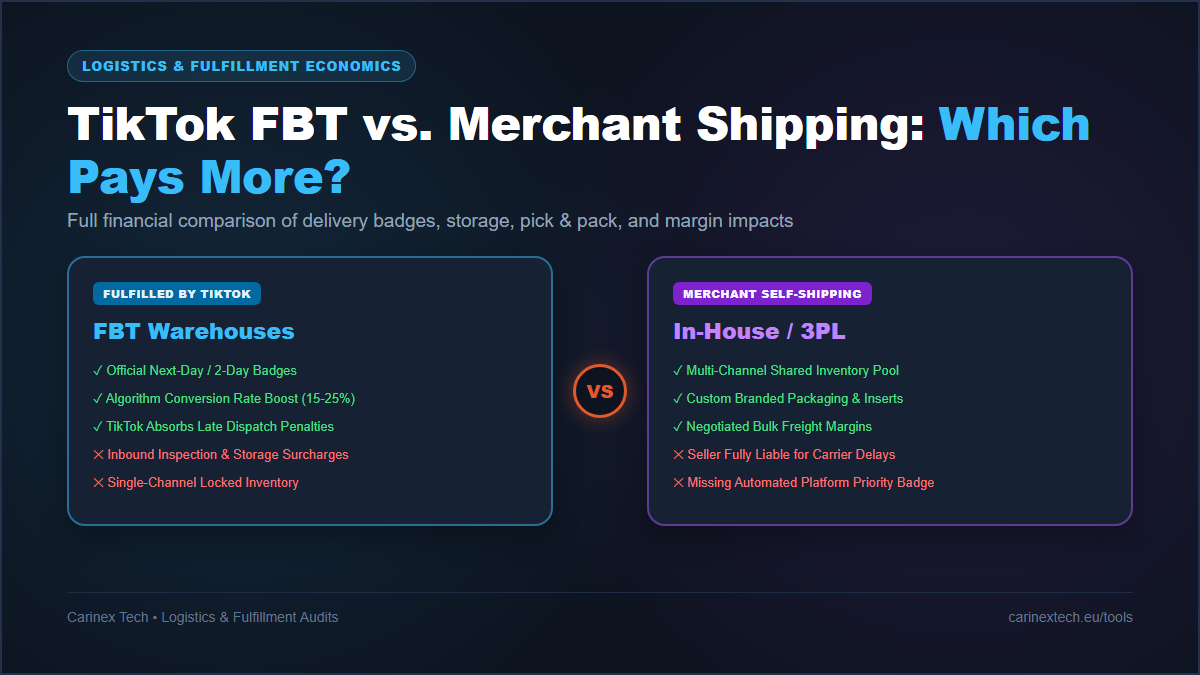
As order volume scales on TikTok Shop, fulfillment becomes the operational bottleneck. Sellers face a critical strategic decision: should you use Fulfilled by TikTok (FBT) or handle order fulfillment independently through self-shipping or a private third-party logistics (3PL) partner?
Both models directly affect your delivery performance ratings and bottom-line profit margins. Let us examine the pros, cons, and financial considerations of each approach.
What Is Fulfilled by TikTok (FBT)?
FBT is TikTok’s automated logistics service, analogous to Amazon FBA. Sellers store inventory within TikTok-partnered warehouse centers, where automated systems pick, pack, and dispatch customer orders as soon as they are placed.
Fulfilled by TikTok (FBT) vs Merchant Self-Shipping
Side-by-side operational and cost trade-offs for a lightweight 8 oz SKU
Advantages of FBT
- Algorithmic Visibility: Products fulfilled through FBT often receive preferred algorithmic exposure and priority placement in search tabs.
- Speed & Trust Badges: Listings display fast-shipping badges (e.g., Next-Day or 2-Day delivery), which seller case studies report can lift listing conversion rates by an estimated 15% to 25% during peak promotions.
- Late Dispatch Protection: TikTok assumes responsibility for carrier delays and shipping-related negative customer feedback.
Disadvantages of FBT
- Structured Fee Schedules: Receiving fees, storage costs (which escalate rapidly after 30–60 days), and pick-and-pack fulfillment rates apply to every unit.
- Strict Inbound Compliance: Precise barcode and palletization standards mean improper shipments face processing delays or penalty surcharges.
When Merchant Self-Shipping Is More Profitable
Self-fulfillment (shipping from your own facility or a dedicated 3PL) remains advantageous in several scenarios:
- Oversized or Heavy Products: FBT storage and handling fees on large items quickly erode margins.
- Multi-Channel Inventory: If you sell across Shopify, Amazon, and TikTok simultaneously, keeping unified inventory in a single 3PL avoids fragmented stockouts.
- Custom Packaging & Inserts: FBT limits branding opportunities; merchant shipping allows custom tissue, stickers, and promotional flyers encouraging buyers to join your direct email list.
Compare Fulfillment Costs Side-by-Side
Plug your exact shipping quotes into our calculator to see how carrier costs change your net take-home profit:
Test FBT vs Self-Shipping Costs Against Your Margin
Plug your exact fulfillment cost per order into our free TikTok Shop Fee & Profit Calculator to see which shipping method leaves more net cash.
Open TikTok Shop Calculator →The Recommendation for 2026
Most top-tier brands adopt a hybrid fulfillment model: place your top 20% best-selling hero SKUs into FBT for maximum viral reach and algorithm advantages, while fulfilling seasonal items and slower-moving variants through independent shipping partners.
Detailed 2026 Cost Breakdown: Fulfilled by TikTok (FBT) vs. Merchant Shipping (3PL / In-House)
Choosing between Fulfilled by TikTok (FBT) and shipping orders yourself (either in-house or through an independent 3PL warehouse) affects far more than your postage expense. It directly governs your Shop Performance Score (SPS), your immunity to Late Dispatch Rate penalties during viral video spikes, and your ability to convert customers with custom branded packaging.
| Fulfillment Dimension | Fulfilled by TikTok (FBT) | Merchant / 3PL Self-Shipping | Strategic Winner |
|---|---|---|---|
| Pick, Pack & Weight Postage (Under 1 lb) | ~$3.58 – $4.45 per single unit (tiered discounts for multi-unit orders) | ~$4.25 – $5.60 via USPS Ground Advantage + 3PL pick fee | FBT on lightweight high-velocity SKUs |
| Heavy / Bulky Items (Over 3 lbs) | Steep dimensional weight surcharges + storage fees | Negotiated regional parcel / UPS Ground Saver rates | Merchant / 3PL for oversized goods |
| Late Dispatch & SLA Penalties | 100% Exempt—TikTok assumes full SLA responsibility | Strict 2-business-day dispatch SLA; violations hurt SPS | FBT during unpredictable viral surges |
| Multi-Channel Inventory Flexibility | Stock locked in FBT warehouses (unless using multi-channel add-ons) | Single inventory pool shared across Shopify, Amazon & TikTok | Merchant / 3PL for omnichannel brands |
| Custom Boxes & Brand Inserts | Standard FBT packaging rules; limited custom unboxing | Full custom mailers, QR warranty cards & gift inserts | Merchant / 3PL for LTV & retention |
| Storage & Aged Inventory Fees | Free initial window (typically 30 days), then escalating per-cubic-foot fee | Predictable monthly pallet or bin rate at your own warehouse | Tie (depends on inventory turnover speed) |
Worked Unit-Economics Case Study: 1,000 Monthly Orders at 10 oz
Let’s compare the real monthly fulfillment cost for a skincare brand shipping 1,000 orders per month (850 single-unit orders and 150 two-unit bundle orders) of a 10 oz boxed serum retailing at $28.00:
- Scenario A — Independent 3PL Fulfillment: You pay $1.25 pick-and-pack for the first unit ($0.40 per additional unit), $0.35 for a branded mailer, and $4.35 average USPS Ground Advantage postage = $5.95 per single order ($6.75 per 2-pack). Across 1,000 orders, your monthly fulfillment outlay is $6,070, plus inbound pallet receiving ($120) = $6,190 total ($6.19/order average).
- Scenario B — Fulfilled by TikTok (FBT): Inbound freight to the FBT hub costs $240. FBT charges a consolidated fulfillment fee of roughly $3.85 per single unit and $5.40 for a 2-unit order (thanks to FBT multi-unit fee reductions), plus ~$85 in monthly storage and receiving = $4,407 total ($4.41/order average).
- Net Fulfillment Savings with FBT: On a fast-moving 10 oz hero SKU, FBT saves roughly $1.78 per order ($1,783/month) while unlocking FBT shipping subsidies and protecting your Shop Performance Score when a creator video drives 400 orders overnight.
When FBT Backfires: Three Operational Traps to Avoid
- Sending Untested / Slow-Moving SKUs Into FBT: FBT is engineered for high-velocity turnover. If you ship 2,000 units of an untested color variant into an FBT warehouse and it only sells 30 units a month, aged storage fees after 60–90 days and per-unit stock removal/return fees will completely erase your postage savings. Always validate velocity via Merchant Shipping first.
- Ignoring Inbound Receiving Lead Times Before Q4 / BFCM: During October and November, FBT warehouse receiving docks can take 7 to 14 days to check in inbound cartons. Keep a Merchant-Fulfilled backup listing (or dual-inventory SKU setup) active so you can switch immediately to in-house dispatch if FBT stock runs dry during a viral campaign.
- High-Return Apparel & Sizing Categories: Because FBT automates customer return approvals for “no longer needed” or sizing issues, apparel brands often see higher return rates on FBT than on merchant-fulfilled orders where customer support can offer an immediate size exchange before a return label is generated.
Frequently Asked Questions: Fulfilled by TikTok (FBT)
Can I use FBT for some products and Merchant Shipping for others?
Yes, and that is the exact setup we recommend for scaling brands. Allocate your top 15%–20% proven, lightweight hero SKUs to FBT to capture the fast-delivery badge and algorithmic boost, while keeping heavy bundles, customizable kits, and new product tests on Merchant Shipping synced with your Shopify warehouse.
Does using FBT lower my 6% TikTok Shop referral fee?
No—the 6% platform referral fee still applies to the customer payment. However, FBT orders frequently qualify for TikTok-funded shipping co-subsidies and higher conversion rates, which lowers your effective customer acquisition cost per order.
Want this for your business?
Book a free 30-minute call. We’ll look at what you have and tell you honestly what’s worth building.